Learn by Doing Activity #005 Can You Find the Volume of an Irregular Object Without Using a Ruler? Displacement, Density & Buoyancy

Can you find the volume
of an irregular
object
without using
a ruler?

Use water displacement to measure an object's volume, calculate density, test whether it floats or sinks, and connect the evidence to Archimedes' principle.

35-50 min Beginner

Check your work: Displacement & Density Calculator
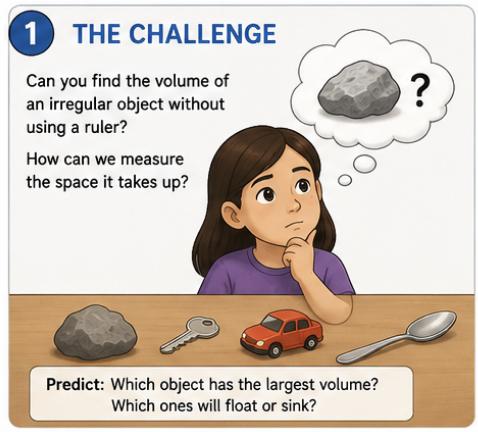
Learner comparing irregular objects and asking whether volume can be found without a ruler.
Start by comparing the objects before measuring anything.

Learn by Doing

Predict Measure Calculate Test Compare Reflect
Real-World Challenge

Set up

Materials

Choose small objects that can safely get wet and fit inside the measuring container.

Materials Required

Required

  • Clear measuring cup or graduated cylinder
  • Water
  • Irregular objects
  • Scale for measuring mass
  • Towel
  • Paper and pencil

Suggested objects

  • Stone
  • Metal spoon
  • Small toy
  • Key
  • Rubber eraser
  • Plastic cap

Safety and measurement notes

Avoid overflow by leaving extra space above the water. Read the water level at eye level. Use only objects that can safely get wet, and dry spills right away.

1

Predict

Compare the objects before testing.

The goal is to make a reasonable prediction, then let the water and measurements challenge your first idea.

Prediction question

Which object do you think has the greatest volume? Which objects do you think will float or sink?

  • Put three to five objects in order from smallest volume to greatest volume.
  • Predict whether each object will float or sink.
  • Explain what clues you used: size, material, weight, shape, or trapped air.
2

Gather

Prepare the water and tools.

Set up the measuring container so each object can be fully submerged without spilling water.
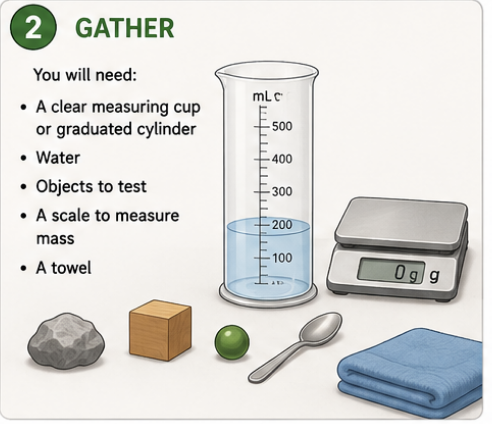
  • Add enough water to cover the object once it is lowered in.
  • Leave room at the top so the water does not overflow.
  • Place the container on a flat surface.
  • Keep the towel nearby.
Measuring cup, water, towel, scale, pencil, and irregular objects arranged for the displacement activity.
A clear container makes the water level easier to read.
3

Measure by displacement

Record the initial and final water levels.

When the object goes underwater, it pushes water out of the way. The rise in water level tells you the object's volume.
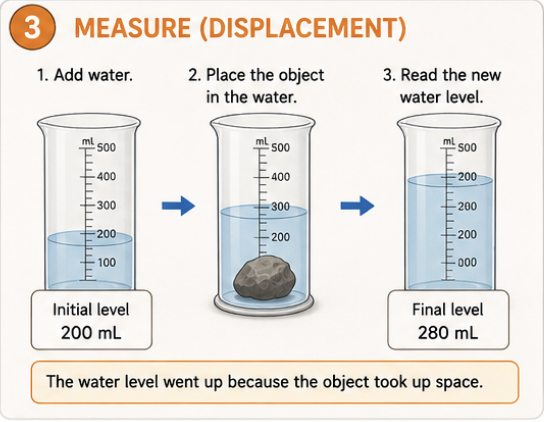
  • Record the initial water level in mL.
  • Slowly submerge one object. Do not drop it.
  • Make sure the whole object is underwater and no water spills out.
  • Record the final water level in mL at eye level.
Learner reading the initial and final water levels in a graduated container after submerging an irregular object.
The water level change is the displaced water.
4

Calculate by hand

Use displaced water to find volume.

The object takes up the same amount of space as the water it displaces.

Formula

Final water level - Initial water level = Displaced water = Object volume

In this activity, 1 mL = 1 cm³. If an object displaces 18 mL of water, its volume is 18 cm³.
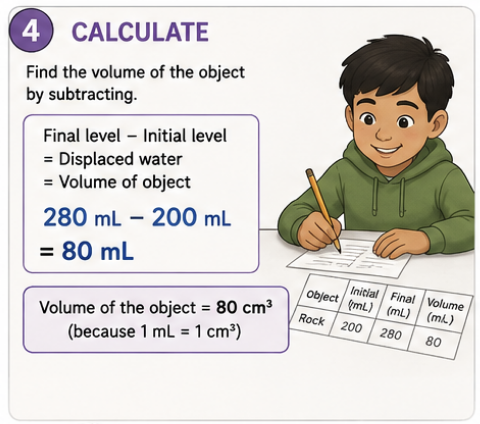
  • Subtract the initial water level from the final water level.
  • Write the answer in mL.
  • Write the same number in cm³.
  • Repeat for each object.
Notebook showing final water level minus initial water level equals object volume.
Use subtraction before opening the calculator.
5

Measure mass and density

Weigh the object and calculate density.

Density compares how much mass is packed into each unit of volume.

Density formula

Density = Mass ÷ Volume

If mass is in grams and volume is in cm³, density is in g/cm³.
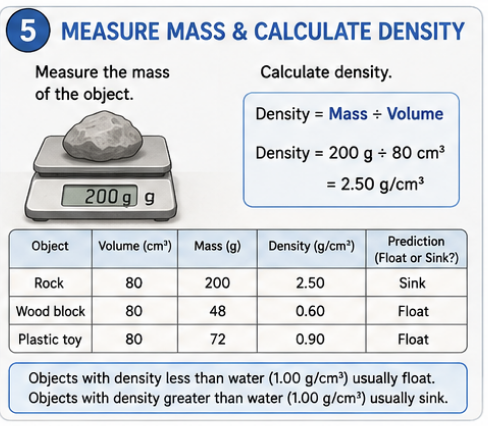
  • Dry the object if needed, then measure its mass in grams.
  • Divide mass by volume.
  • Compare the density with water, which is about 1 g/cm³.
Learner weighing an object and dividing mass by volume to calculate density.
Mass and volume work together to explain density.
6

Test and compare

Test whether each object floats or sinks.

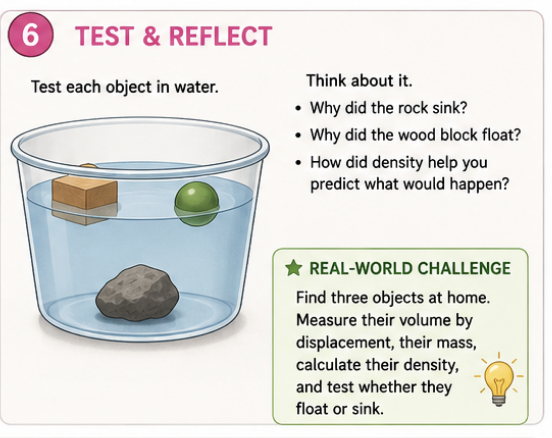
Compare your float/sink prediction with the object's density and the real result.

  • Did objects with density less than 1 g/cm³ float?
  • Did objects with density greater than 1 g/cm³ sink?
  • Did shape, trapped air, or partial submersion affect the test?
  • How did the actual result compare with your prediction?

Compare after hand work

Displacement & Density Calculator

Enter your initial water level, final water level, and optional mass after you have completed the hand calculation.
Open Calculator
Learner comparing floating and sinking results with object density notes.
The calculator checks the work; it does not replace the experiment.
7

Discover

Connect your evidence to Archimedes' principle.

Water pushes upward on objects. That upward push is called buoyant force.

Why does a huge, heavy boat float?

A boat is hollow and contains a lot of air, so the whole boat has a large volume and a relatively low average density. Steel itself is denser than water, but the average density of the ship plus the air inside can be less than the density of water. The boat's shape allows it to displace a large amount of water. As it settles into the water, the buoyant force increases until it balances the boat's weight. When a boat is floating steadily, the buoyant force equals its weight.
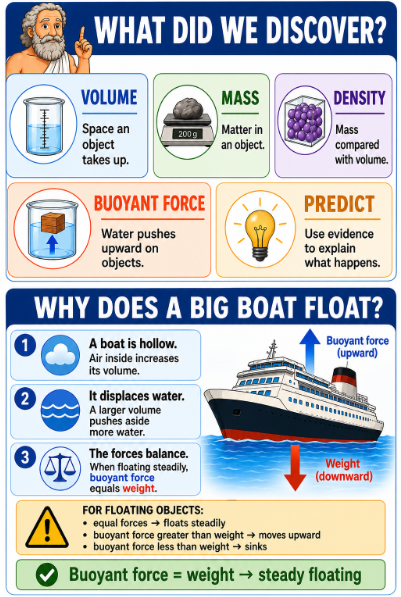
  • More displaced water means more upward buoyant force.
  • An object floats when the water's upward push can balance the object's weight.
  • An object sinks when it cannot displace enough water before going under.
  • Average density helps explain hollow objects, boats, and objects with trapped air.
Large ship floating because its hollow shape displaces enough water to balance its weight.
A floating boat is heavy, but it displaces enough water for buoyant force to balance its weight.
8

Reflect

Explain what changed in your thinking.

Use your predictions, measurements, calculations, and tests as evidence.

Reflection questions

  • Which object surprised you most?
  • Was volume or mass easier to predict by looking?
  • How did density help explain floating or sinking?
  • What would you measure more carefully next time?
9

Apply

Real-World Challenge

Choose a real object and explain whether water displacement is a good way to find its volume.

Design a float test

Choose a safe waterproof object, measure its volume by displacement, calculate density, test whether it floats, and explain the result using mass, volume, average density, and buoyant force.

Activity sheet

Activity Sheet #005: Can You Find Volume Without a Ruler?

Record predictions, water levels, calculated volume, mass, density, float/sink results, reflections, and the Real-World Challenge.